Honestly? There's no wrong answer. Unless you have a diagnosed metal allergy confirmed by a doctor, this decision comes down to two things: aesthetics and cost. That's genuinely it.
I am only ever talking about implant-grade ASTM F-136 titanium and solid 14ct gold, sourced from verified wholesalers who have gone through the APP process. Whatever goes in your body needs to be biocompatible. Not all jewellery marketed as body jewellery actually is.
The honest answer
If you're a gold person, get gold. If you like the look of titanium, get titanium. If you want gold warmth in silver tones, white gold exists and it's beautiful. Really, that's the whole decision for most people.
There's a lot of noise online about one being better from a healing perspective. With properly sourced high-grade materials, both heal just as well for the vast majority of people. If your doctor has confirmed an allergy to a specific metal, that changes things. In the absence of a confirmed allergy, please don't choose your jewellery based on internet forums. With quality materials, both are excellent.
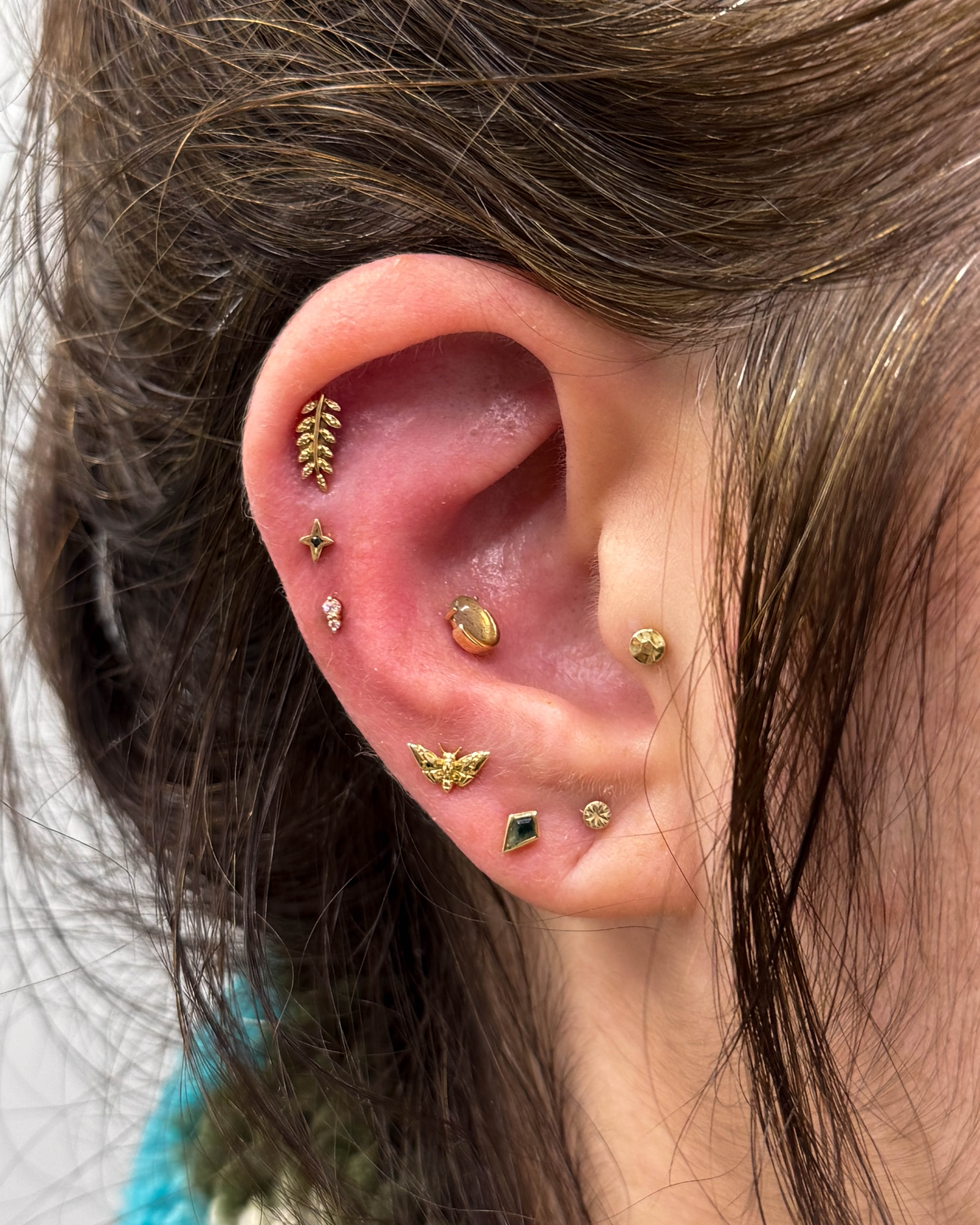
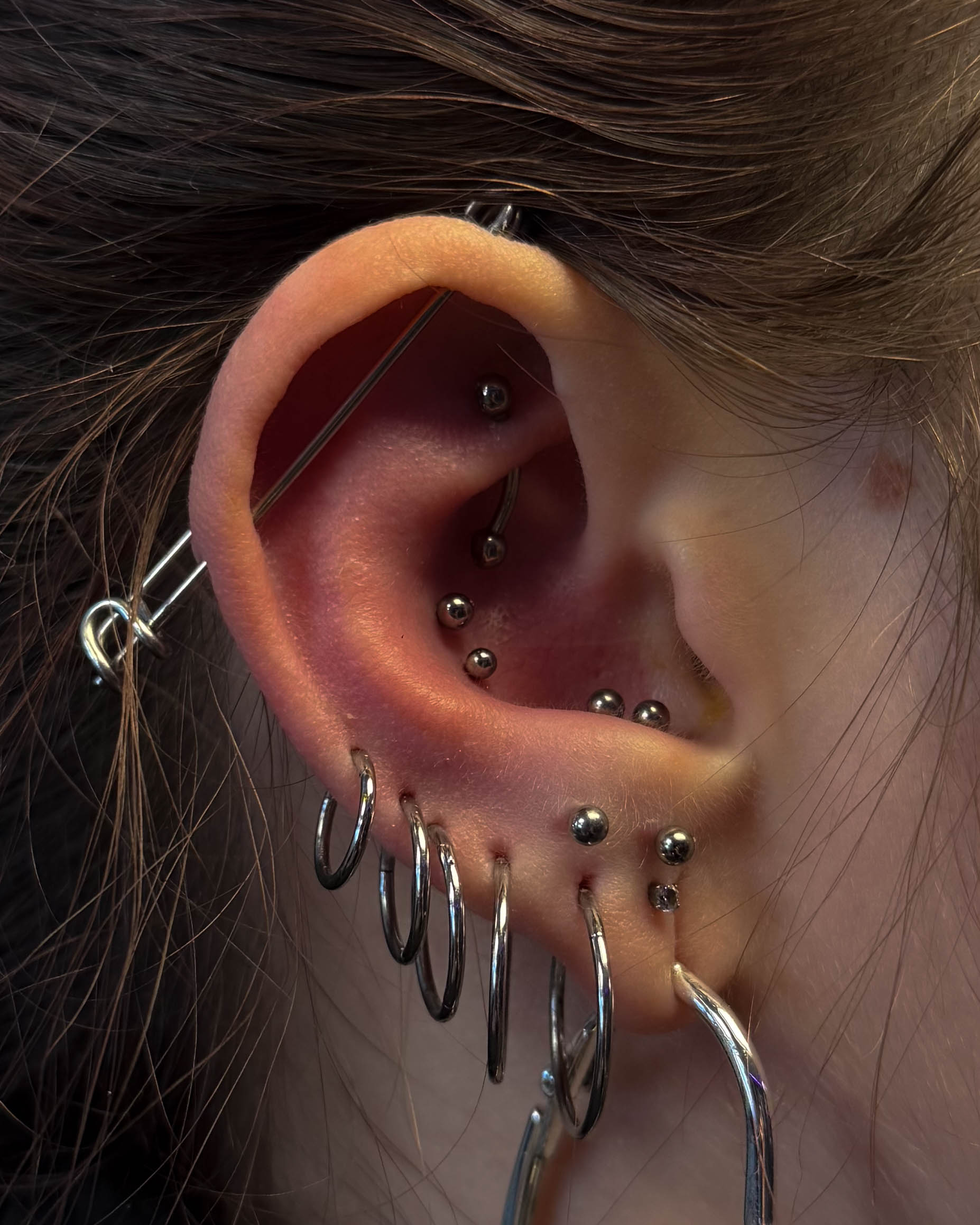
Left: a full yellow gold curation. Right: a titanium curation. Both beautiful, both body-safe, completely different aesthetics.
Where titanium has its limits
Titanium is excellent for all the basics: labrets, bars, curves, balls. It's what all your backing pieces will be made from regardless of what front you choose. But if you want tiny, dainty, intricate pieces with fine detail, titanium isn't going to get you there. It's an incredibly hard metal to work with at small scale, which limits how delicate the designs can be.
Gold is malleable and strong once formed. This is what allows the industry to produce impossibly small floral pieces, insects, fine-set gemstone ends, the details that make an ear curation feel genuinely bespoke. If you want the delicate stuff, you're looking at gold.
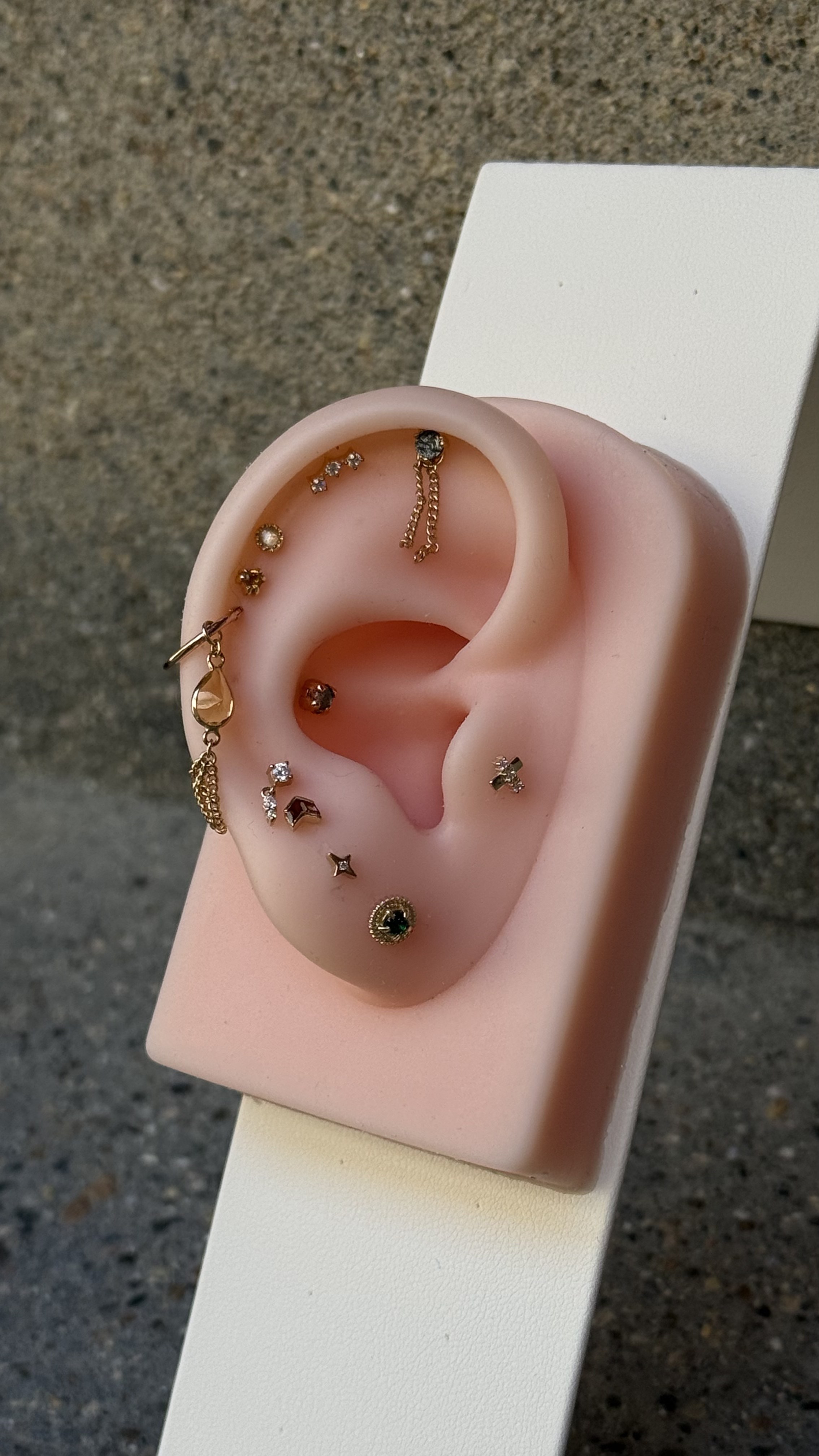
The range of what's possible with gold: from tiny delicate pieces to statement drops.
On the cost
If you want a tiny piece with a real emerald in 14ct gold that is fully body-safe and will genuinely outlast a cockroach in the apocalypse, yes, it will cost you. Sometimes a lot.
But here's the reframe: this is not a purchase, it's an investment. These pieces can become family heirlooms. They don't tarnish, they don't degrade, they don't need replacing. The cost of gold has risen significantly over the last few years, which directly affects what wholesalers charge and therefore what we charge you. Nobody in this chain is sitting on a huge margin. What you're paying for is quality, longevity, and safety.
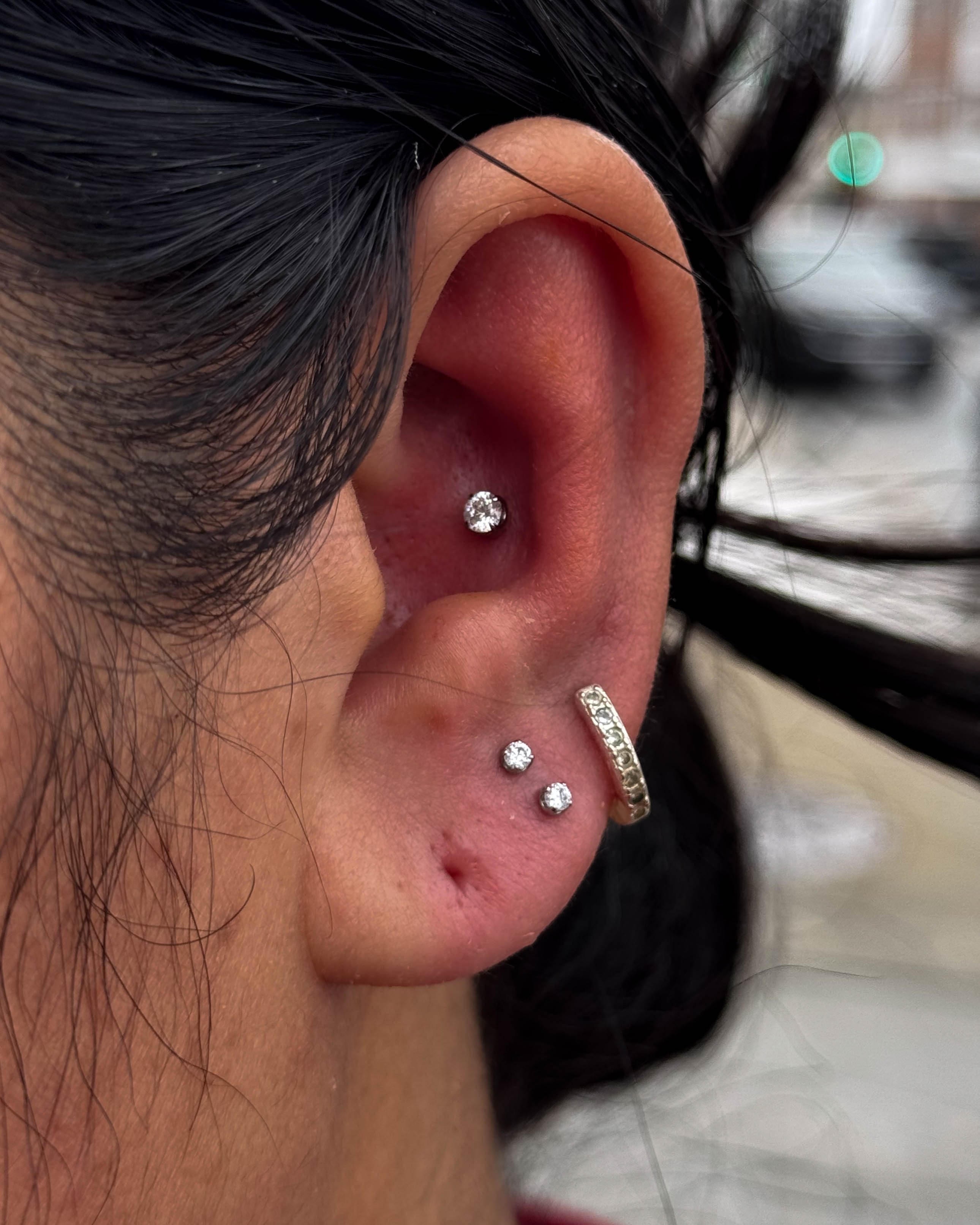
Titanium pieces from Junipurr, CZ Prong setting, stunning in any placement
Threading, and why it matters more than you think
This goes hand in hand with the quality of jewellery you're buying. There are three types of threading in piercing jewellery.
Internally threaded means the thread is on the front piece, which screws into the smooth backing. Safe, widely used, particularly good for curved bars and larger fronts that benefit from a secure connection.
Threadless means the front has a small straight pin that slides into the backing. A slight bend at the halfway point creates tension that keeps it in place. It sounds precarious. It is not. This is the most common system for gold fronts and one of the most elegant solutions in the industry.
Externally threaded is the one to avoid. (If someone offers you this, hiss at them until they reconsider.) The thread sits on the bar itself and drags through your piercing channel every time it's inserted. Sharp, uncleanable ridges through living tissue. It causes micro tears, irritation, and in serious cases, infection. It is cheap to produce, which is why it's everywhere in low-quality body jewellery. It will never go in your body in my studio.
A quick note on butterfly backs
Almost all of us have had one at some point. I have personally had to cut them out of people's ears, mostly children who got pierced at Claire's, and that is a whole separate post I will write one day. Butterfly backs are problematic for a few reasons: the materials are typically mystery metals, the gauge is often inconsistent, and the backing mechanism creates too much pressure on the piercing site, causing inflammation and in some cases the back embedding into the skin.
If you have children whose ears were pierced somewhere like this, come in and let me assess them. It's not about judgment. It's about making sure they're comfortable and healing properly.
The most important factor in safe jewellery isn't the metal. It's who is selling it to you and where they're getting it from.
Gold or titanium, both are excellent with proper quality materials. Gold gives you more design options at smaller scales. Titanium is your workhorse for backings and basics. Whatever you choose, make sure it's coming from a piercer who sources properly.
Want to see the jewellery in person? Come in for a consultation and we'll go through everything together.
Book a consultation